


What Is a Zipper Slider? — Complete Guide for Fashion Brands & Bag Makers
Understanding the mechanical heart of your zipper — how it works, compatibility, customization, and
What Is a Zipper Slider? — Complete Guide for Fashion Brands & Bag Makers
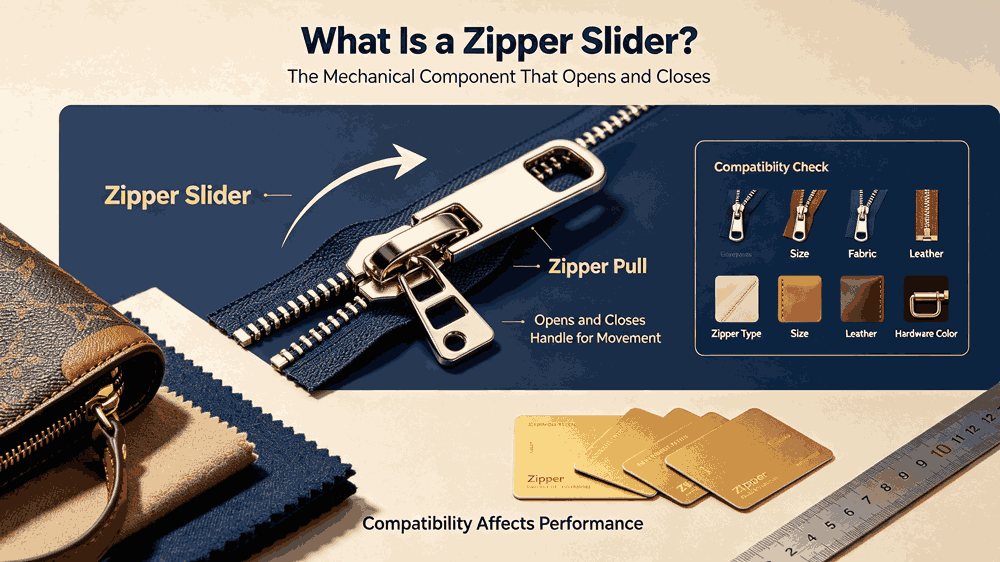
Understanding the mechanical heart of your zipper — how it works, compatibility, customization, and how to select the right one for your product.
A zipper slider is the moving component that opens and closes a zipper. It travels along the zipper elements (teeth or coil) and joins or separates them as it moves.
Without a slider, a zipper is simply two rows of teeth that cannot interlock. The slider is the mechanism that makes a zipper function.
This guide covers everything you need to know — from how sliders work to compatibility, types, customization options, and how to select the right one for your product.
Zipper Slider vs. Zipper Pull: What's the Difference?
These terms are often used interchangeably, but they are different components with different functions.
| Component | Function | Analogy |
|---|---|---|
| Slider | Performs the mechanical work — joins or separates zipper teeth | The "engine" of the zipper |
| Pull / Puller | Provides the handle used to move the slider | The "steering wheel" or "handle" |
Key point: A slider can function without a pull (though it is difficult to use). A pull cannot function without a slider. They work together but are separate components, and each can be customized independently.
How Does a Zipper Slider Work?
The slider operates on a simple mechanical principle — it is designed with a Y-shaped channel inside.
How the Y-channel works:
Closed position: Both sides of the zipper teeth enter the wide end of the Y-shaped channel
Moving up (closed): The channel gradually forces the two rows of teeth together, interlocking them
Moving down (open): The channel pushes the teeth apart, separating them
This simple but effective design has remained essentially unchanged for over 100 years. The slider's precision determines how smoothly the zipper operates and how well it holds.
Why Is Slider Compatibility Important?
A slider must match the zipper type, size, and material. Using an incompatible slider can cause significant problems:
| Issue | What Happens | Consequence |
|---|---|---|
| Poor movement | Slider drags or sticks | Difficult to open/close, frustrating for end users |
| Poor closure | Teeth do not interlock fully | Zipper pops open under pressure |
| Reduced durability | Extra friction and wear | Slider or teeth fail prematurely (5,000 cycles vs. 20,000+) |
| Appearance issues | Slider is too large or small for the zipper | Visually unappealing, looks mismatched |
Matching checklist:
Zipper type: Metal zippers require metal-compatible sliders; nylon coil requires nylon-compatible sliders
Zipper size: #3 slider on #3 chain — never mix sizes
Teeth material: Slider design must match the teeth profile (Y-shape for coil, V-shape for metal)
Common Zipper Slider Types
| Slider Type | Mechanism | Best For |
|---|---|---|
| Auto Lock | Spring-loaded, locks automatically when not in use | Apparel, jackets, bags — prevents zipper from sliding open |
| Non-Lock | Free-moving, no locking mechanism | Luggage, tents, backpacks — where free movement is desired |
| Pinch / Pull-less | Pinch to release, no external pull tab | Minimalist bags, hidden zippers, footwear |
| Reversible | Double-sided, can be operated from both directions | Jackets, coats, reversible garments |
| Reverse Slider | Slider body is on the back side of the zipper | Clean-front garments, hoodies, hidden zippers |
| Tape Slider | Designed for zipper tape and yardage | Custom length zippers, aftermarket repairs |
Slider Construction & Materials
| Material | Characteristics | Cost Level | Best For |
|---|---|---|---|
| Zinc Alloy | Cast, smooth surface, takes electroplating well | $$ | Custom sliders, fashion applications |
| Brass | Stamped, strong, premium feel | $$$ | High-end bags, luxury apparel |
| Aluminum | Lightweight, corrosion-resistant | $$$ | Outdoor gear, aerospace, marine |
| Nylon / Plastic | Molded, lightweight, quiet operation | $ | Lightweight apparel, sportswear |
| Stainless Steel | Heavy, extreme durability | $$$$ | Industrial, tactical, marine |
Slider Finishes & Customization
Depending on the project, buyers can customize the appearance of both the slider and the pull. For fashion applications, the hardware can be selected to complement:
Fabric color and texture
Leather type and finish
Bag design aesthetic
Brand identity guidelines
Hardware color palette
Available finishes:
| Finish | Look | Application |
|---|---|---|
| Nickel | Silver, classic, affordable | General use |
| Gold / Bright Gold | Warm, premium | Luxury bags, evening wear |
| Black / Matte Black | Modern, edgy | Outdoor gear, streetwear |
| Gunmetal | Industrial, sophisticated | Premium accessories |
| Rose Gold | Feminine, trendy | Women's apparel |
| Antique Brass | Vintage, rustic | Denim, retro products |
| Chrome | High-shine silver | Automotive, fashion |
How to Specify a Slider for Your Project
When ordering custom zipper hardware, buyers should clearly specify whether they need the complete zipper, slider, pull, or another component.
Here is a simple checklist for specifying sliders:
| Specification | Questions to Answer | Example |
|---|---|---|
| Zipper type | Which zipper chain will it be used on? | Nylon coil #5 |
| Zipper size | #3, #5, #8, #10? | #5 |
| Slider type | Auto lock, non-lock, pinch, reversible? | Auto lock |
| Material | Zinc alloy, brass, aluminum, plastic? | Zinc alloy |
| Finish | Which color or plating? | Nickel |
| Pull style | Ring, tab, custom, logo? | Custom logo pull |
| Application | Where will it be used? | Jackets, handbags, etc. |
What to send to your manufacturer:
"I need an auto-lock slider for a #5 nylon zipper chain. The slider should be in zinc alloy with a nickel finish. I will provide a custom pull design separately."
Common Slider Problems & Solutions
| Problem | Possible Cause | Solution |
|---|---|---|
| Slider doesn't move smoothly | Incompatible slider or worn teeth | Match slider to zipper type; replace worn slider |
| Slider won't stay closed | Worn lock mechanism | Replace slider; check if auto-lock mechanism is damaged |
| Zipper pops open under pressure | Incorrect slider tension or worn teeth | Adjust or replace slider; check for broken teeth |
| Slider jumps off the track | Damaged teeth or missing stop | Replace missing stop or damaged teeth; replace slider |
| Slider pulls are difficult to grip | Wrong pull style for the application | Select larger, textured pull for heavy use |
Industry Standards & Testing
For brands selling in the EU and US markets, sliders must meet certain quality standards:
| Test | What It Measures | Typical Standard |
|---|---|---|
| Pull force test | How much force is required to open/close the zipper | ASTM D2061 |
| Crosswise strength | Resistance to lateral force | ASTM D2061 |
| Locking strength | Resistance to unintentional opening | ASTM D2061 |
| Salt spray test | Corrosion resistance of plated sliders | 24-72 hours |
| Cycle test | Durability over repeated use | 10,000+ cycles |
Note: Most industry standards apply to the complete zipper assembly. However, sliders are often tested as part of the overall zipper system.
Conclusion
The zipper slider is the mechanical heart of the zipper. Understanding how it works, how to match it with your zipper, and how to customize it helps you make better sourcing decisions.
When ordering custom zipper hardware, buyers should clearly specify whether they need the complete zipper, slider, pull, or another component. A clear specification helps the manufacturer quote accurately and deliver exactly what you need.
JC Fashion Accessory offers custom sliders and pulls for all zipper types — with full compatibility, finish, and color options, plus design support and testing.
Ready to specify your zipper slider?
Contact JC Fashion Accessory with your zipper type and requirements — we'll help you find the right match.


Zip code: 322023

